
What Is Mailwarm? Examining the Email Warmup Tool
TL;DR
Mailwarm is an automated email warmup tool with a network of more than 50,000 real, aged inboxes, continuous placement monitoring, blacklist monitoring, and access to deliverability experts. It covers the core features most senders need, but starts at $69 per month with annual billing or $79 month to month for a single inbox.
Mailwarm has built its product around a relatively simple proposition: connect an inbox, let automated warmup build sending activity, and monitor what happens to your deliverability along the way.
It also takes a more hands-on approach than many warmup tools, with recurring calls with a deliverability expert included in every plan.
We reviewed Mailwarm’s current product documentation, pricing, and available user feedback to see what Mailwarm offers in 2026 and whether it’s worth the price.
Key takeaways
- Mailwarm automates email warmup, gradually increasing sending activity rather than starting at full volume.
- Its network includes more than 50,000 real, aged inboxes.
- Deliverability features include continuous inbox placement monitoring and blacklist detection.
- Every plan includes access to a deliverability expert, ranging from one call per month on Starter to on-demand calls on Scale.
- Pricing starts at $69 per month with annual billing or $79 month to month for one inbox.
Where Mailwarm started
Mailwarm launched as a dedicated email warmup tool, built to help senders establish a reputation before scaling their email activity.
The basic process is still at the center of the product. Mailwarm sends warmup emails through its network, then generates engagement through actions such as opens, replies, important markings, and spam rescues.
In June 2026, the company launched Mailwarm 2.0, expanding the product beyond warmup. The updated version added inbox placement monitoring, provider-level warmup, infrastructure checks, and deliverability expert calls alongside the original automated warmup process.
Mailwarm’s key features
Mailwarm keeps automated warmup at the center of the product, with monitoring and expert guidance built around it.

Automated warmup and engagement signals
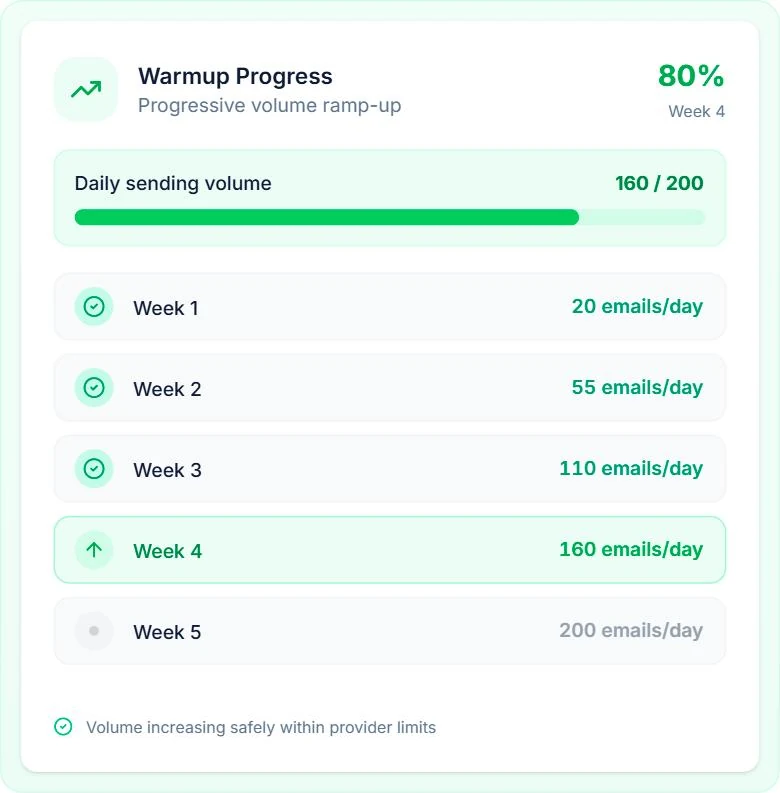
Warmup begins automatically once an inbox is connected, with no manual scheduling required. Sending volume ramps gradually rather than starting at full capacity, giving the inbox time to build sending activity over time.
Mailwarm says each warmup email generates five separate signals, including opens, replies, important markings, spam rescues, and a bounce-rate improvement signal.
Warmup network
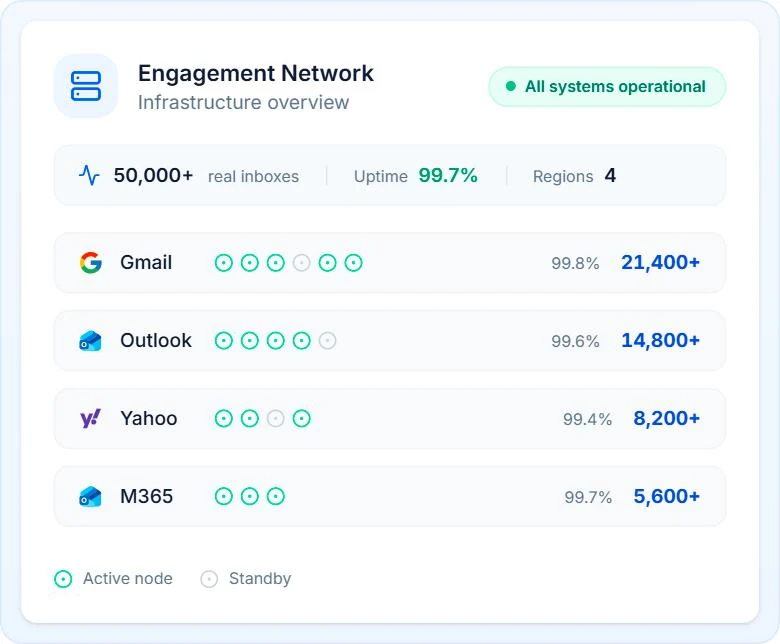
Mailwarm says its network contains more than 50,000 real, aged inboxes. Warmup messages are exchanged across this network to generate the engagement activity used during the warmup process.
The size is one of Mailwarm’s more prominent selling points. However, its public documentation provides relatively little information about how inboxes are admitted to the network or what checks they undergo once they’re there.
Inbox placement and blacklist monitoring
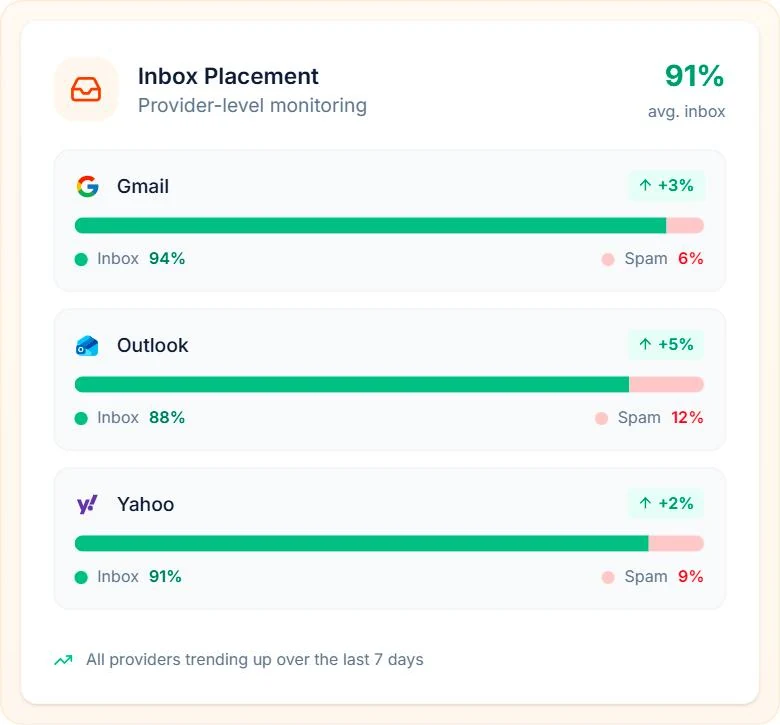
Mailwarm monitors whether emails reach the inbox or spam folder alongside the warmup process. It describes this as 24/7 continuous placement monitoring, with results available by mailbox and SMTP provider.
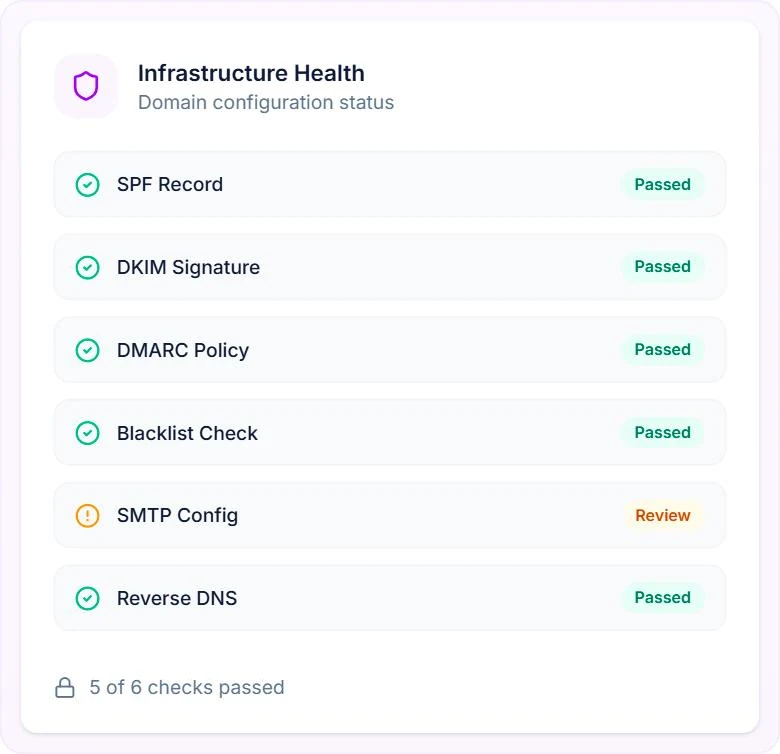
Blacklist monitoring is included as well, checking for listings across major blacklist databases. Mailwarm doesn’t publish a specific polling interval, so we couldn’t verify how frequently those checks run.
Deliverability expert access
Every Mailwarm plan includes calls with a deliverability expert. Starter includes one call per month, Growth includes four, and Scale provides on-demand access.
That gives teams somewhere to take account-specific problems when the dashboard tells them something is wrong but not necessarily why.
Mailwarm pricing
Mailwarm prices its plans by the number of email accounts included, with both monthly and annual billing available. All three plans include automated warmup, placement monitoring, and access to a deliverability expert, but the amount of expert support increases at higher tiers.
| Plan | Email accounts | Monthly billing | Annual billing |
| Starter | 1 user, 1 mailbox/SMTP | $79/month | $69/month |
| Growth | 2 users. 3 mailboxes/SMTPs | $189/month | $159/month |
| Scale | 5 users, 10 mailboxes/SMTPs | $549/month | $479/month |
Even at the entry level, Mailwarm sits at the expensive end of email warmup. A single inbox costs $79 month to month, and managing 10 accounts on Scale costs $549 per month.
Note: All prices are current as of September 2026. Please verify live pricing before purchase.
What Mailwarm users say
Mailwarm has a relatively small pool of public reviews, which makes it harder to draw broad conclusions from user feedback than it is for products with hundreds of recent reviews.
Users generally praise Mailwarm’s ease of setup, automated warmup, and deliverability support. Positive feedback also mentions assistance with technical issues such as DNS configuration.
Criticism centers on price, limited customization, and reporting depth.
| Pros | Cons |
| Automated warmup with gradual volume increases | Considerably more expensive than many dedicated warmup tools |
| Large inbox network (over 50,000) | Expert consulting is bundled into the price whether you need it or not |
| Continuous inbox placement monitoring | Limited pool of independent user reviews |
| Blacklist monitoring | No built-in campaign sending |
Who is Mailwarm best for?
Mailwarm is best suited to teams that want automated warmup alongside ongoing deliverability monitoring and expert support. In particular, it may suit:
- Teams troubleshooting persistent deliverability problems: Mailwarm’s expert calls give you somewhere to take problems with sender reputation, authentication, inbox placement, or email infrastructure when automated monitoring isn’t enough to identify the cause.
- Sales teams with an existing outreach stack: Mailwarm handles warmup and deliverability monitoring separately from campaign sending, so you can use it alongside the outreach tools already in your workflow.
- Teams managing multiple sending accounts: Growth and Scale cover three and 10 mailboxes/SMTPs respectively, with more frequent expert access as you move up the plans.
- Teams without in-house deliverability expertise: The included expert calls give teams access to human guidance without having to diagnose every deliverability issue internally.
Do you need Mailwarm’s higher-touch approach?
The main question is whether you’ll use the expert access you’re paying for. If you’re dealing with deliverability problems you can’t diagnose internally, having recurring calls included in the subscription could justify the higher price.
If you mainly need automated warmup and monitoring, it’s harder to make the same case. Those features are available from lower-cost tools, so much of Mailwarm’s added value comes down to whether you need regular access to a deliverability expert.
Warmup Inbox for email warmup
Warmup Inbox offers automated warmup across a network of more than 30,000 active inboxes, including customer accounts and internally managed inboxes used exclusively for warming. Newly connected inboxes are tested before they’re admitted to the network.
Alongside warmup, Warmup Inbox monitors inbox placement and spam rates in real time, checks more than 50 blacklists hourly, and includes customer support on every paid plan. You can also control warmup volume and run outreach with built-in campaign sending.
The biggest difference is price. Warmup Inbox starts at $19 per inbox with monthly billing or $15 per month with annual billing, with lower per-inbox pricing as you add more inboxes. Mailwarm starts at $79 monthly or $69 per month with annual billing for a single account.
If you primarily need automated warmup, monitoring, and support, Warmup Inbox covers those core capabilities at a much lower starting price.
Frequently Asked Questions
<strong>Is Mailwarm an automated email warmup tool?</strong>
Yes. Mailwarm automatically sends warmup emails and generates engagement signals including opens, replies, important markings, and spam rescues. Sending activity increases gradually as the inbox warms up.<strong>How much does Mailwarm cost?</strong>
Mailwarm starts at $79 per month for one inbox with monthly billing or $69 per month with annual billing. Higher tiers support more email accounts and include more frequent access to Mailwarm’s deliverability experts.<strong>Does Mailwarm monitor inbox placement?</strong>
Yes. Mailwarm provides 24/7 continuous placement monitoring to track whether emails are reaching the inbox or spam folder. It also includes blacklist monitoring alongside its automated warmup features.<strong>What is the difference between Mailwarm and Warmup Inbox?</strong>
Both Mailwarm and Warmup Inbox automate email warmup and provide placement and blacklist monitoring. Mailwarm takes a higher-touch approach, with recurring deliverability expert calls included in every plan. Warmup Inbox starts at a much lower price and offers more control over warmup settings, along with customer support and campaign sending.